September 28, 2021 . 4 MIN READ
A minimum viable product (MVP) is a version of a product with just enough features to be usable by early customers who can then provide feedback for future product development.[1][2]
A minimum viable product has just enough core features to effectively deploy the product, and no more. Developers typically deploy the product to a subset of possible customers—such as early adopters thought to be more forgiving, more likely to give feedback, and able to grasp a product vision from an early prototype or marketing information. This strategy targets avoiding building products that customers do not want and seek to maximize information about the customer with the least money spent. The technique falls under the Lean Startup methodology as MVPs aim to test business hypotheses and validated learning is one of the five principles of the Lean Startup method.[12] It contrasts strongly with the traditional “stealth mode” method of product development where businesses make detailed business plans spanning a considerable time horizon. Steve Blank posited that the main principle of the Lean Startup approach rests in the validation of the hypotheses underlying the product by asking customers if they want the product or if the product meets their needs, and pivoting to another approach if the hypothesis turns out to be false.[11] This approach to validating business ideas cheaply before substantial investment saves costs and limits risk as businesses that upon experimentation turn out to be commercially unfeasible can easily be terminated. It is especially important as the main cause of startup failure is the lack of market need,[13] that is, many startups fail because their product isn’t needed by many people, and so they cannot generate enough revenue to recoup the initial investment. Thus it can be said that utilizing an MVP would illuminate a prospective entrepreneur on the market demand for their products.
An example would help illustrate: in 2015, specialists from the University of Sydney devised the Rippa robot to automate farm and weed management.[14] Before it was released, the technical hypothesis — that the robot can distinguish weeds from farm plants — had already been proven. But the business hypothesis — that it would be a viable tool on a working farm — still needed to be proved.[15] The application of the MVP method here is that the business hypothesis, and only if it proves successful will further development be invested.
“The minimum viable product is that version of a new product a team uses to collect the maximum amount of validated learning about customers with the least effort.”[2] The definition’s use of the words maximum and minimum means it is not formulaic. It requires judgment to figure out, for any given context, what MVP makes sense. Due to this vagueness, the term MVP is commonly used, either deliberately or unwittingly, to refer to a much broader notion ranging from a rather prototype-like product to a fully-fledged and marketable product.[16]
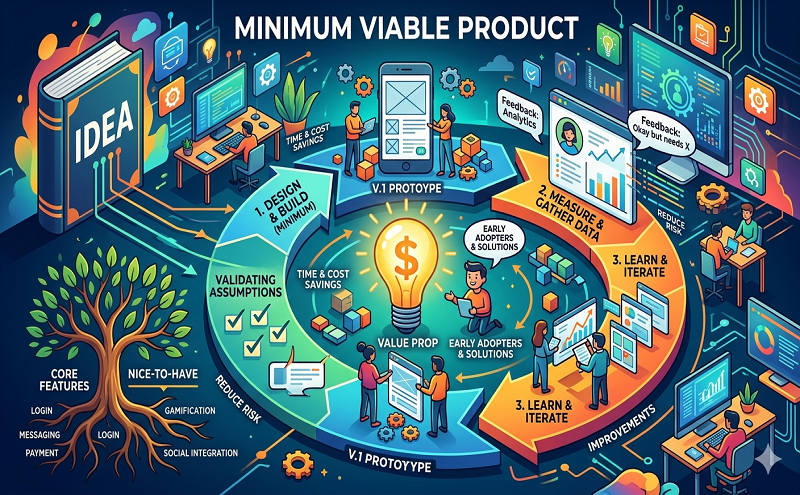
An MVP can be part of a strategy and process directed toward making and selling a product to customers.[17] It is a core artifact in an iterative process of idea generation, prototyping, presentation, data collection, analysis and learning. One seeks to minimize the total time spent on an iteration. The process is iterated until a desirable product/market fit is obtained, or until the product is deemed non-viable.
Steve Blank typically refers to minimum viable product as minimum feature set.[18][19]
Resource & read more: https://en.wikipedia.org/wiki/Minimum_viable_product