
March 1, 2023 . 4 MIN READ
You can delete object versions from Amazon S3 buckets whenever you want. You can also define lifecycle configuration rules for objects that have a well-defined lifecycle to request Amazon S3 to expire current object versions or permanently remove noncurrent object versions. When your bucket has versioning enabled or the versioning is suspended, the lifecycle configuration actions work as follows:
Expiration action applies to the current object version. Instead of deleting the current object version, Amazon S3 retains the current version as a noncurrent version by adding a delete marker, which then becomes the current version.NoncurrentVersionExpiration action applies to noncurrent object versions, and Amazon S3 permanently removes these object versions. You cannot recover permanently removed objects.For more information about S3 Lifecycle, see Managing the lifecycle of objects and Examples of S3 Lifecycle configurations.
To see how many current and noncurrent object versions that your buckets have, you can use Amazon S3 Storage Lens metrics. S3 Storage Lens is a cloud-storage analytics feature that you can use to gain organization-wide visibility into object-storage usage and activity. For more information, see Using S3 Storage Lens to optimize your storage costs. For a complete list of metrics, see S3 Storage Lens metrics glossary.
Normal Amazon S3 rates apply for every version of an object that is stored and transferred, including noncurrent object versions. For more information, see Amazon S3 pricing.
A DELETE request has the following use cases:
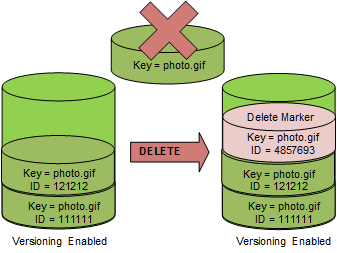
DELETE cannot permanently delete an object. (A simple DELETE request is a request that doesn’t specify a version ID.) Instead, Amazon S3 inserts a delete marker in the bucket, and that marker becomes the current version of the object with a new ID.When you try to GET an object whose current version is a delete marker, Amazon S3 behaves as though the object has been deleted (even though it has not been erased) and returns a 404 error. For more information, see Working with delete markers.
The following figure shows that a simple DELETE does not actually remove the specified object. Instead, Amazon S3 inserts a delete marker.
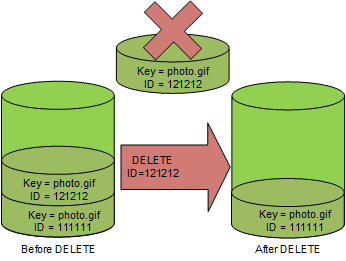
To delete versioned objects permanently, you must use DELETE Object versionId.
The following figure shows that deleting a specified object version permanently removes that object.
You can delete object versions in Amazon S3 using the console, AWS SDKs, the REST API, or the AWS Command Line Interface.
Reference:
https://docs.aws.amazon.com/AmazonS3/latest/userguide/DeletingObjectVersions.html